He and I were both in the same section in the same school, in class XI. We were both studying Physics, Chemistry and Mathematics as the main subjects, besides English and Punjabi as the the auxiliary ones. Both of us were also coached by private tutors, in order to prepare us for entrance examinations for engineering courses. We even lived in the same sector in Chandigarh.
However, his father worked for the government and mine for a private company. They had their own house and we lived in rented accomodation. My father owned a beat-up, second-hand car, while his had a spanking new model. I used to go to school on a bicycle and he had a motor-bike. I asked my parents for money only when I had to buy something essential, while he used to get a lavish allowance. His father obviously managed to earn some 'extra income', being a highly-ranked official involved with granting permits, licences, etc., for which he was said to charge a certain 'fee' from those whom he 'obliged' with his signature and official rubber-stamp.
Still, my class-fellow and I were friends and visited each other's homes often, after school. We were part of the same gang and often hung out together, along with all the other guys, or went to the movies, trips to the Sukhna Lake, etc.
Two years went by, almost in a flash, and soon it was time to appear for the various competitive examinations. Over these couple of years, I realised that although I had taken up the subjects that I had, I did not really have a head for calculus or trigonometry, which was reflected in my below-average scores. Anyhow, I decided to appear for the Combined Entrance Test for admission to engineering and architechture courses in Punjab and Chandigarh (which is a Union Territory, even though it is the capital of the states of Haryana and Punjab). I was placed around 10,000 among approximately 16,000 candidates. Since there were only about 2500 seats available in all, I saw no point in filling in the admission forms.
So, I was obviously surprised when I found him filling up an admission form, even as he had been ranked around 10,500. When I asked him about it, he said his father had told him to do so and he was complying with that. It was only later that I learnt that he had been admitted to the best architecture college i.e. the one at Punjab University, Chandigarh, in the reserved quota, because he belonged to one of the Scheduled Castes.
Later, when I had earned a B.A. degree from a local college and was to leave for Indore in the state of Madhya Pradesh to pursue an M.B.A., he was in the second year of his course, having finally cleared the first year examinations after several failed attempts. It was too bad that there was no reserved quota that could have helped him clear his B.Arch. examinations, as there would have been for promotions in the (reserved) government job that would have been waiting for him as soon as he graduated, so as to ensure that he retires as a high-ranking government official!
I am reminded of all this whenever I read a news report about some politician having made a statement against the directive issued by the Supreme Court of India for excluding the 'creamy layer' i.e. the economically well-off among the Scheduled Castes, Scheduled Tribes and the Other Backward Castes from reservations in admissions to courses of higher education as well as selections for government jobs and promotions while serving therein.
Wednesday, November 29, 2006


Tuesday, November 21, 2006
In The Line of Fire...
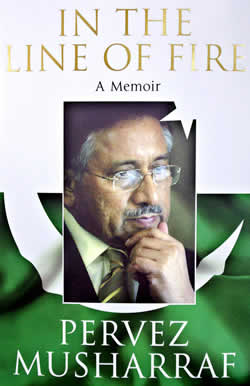
The other day I was watching the movie starring Clint Eastwood, after which General Musharraf has decided to name his book (I refrain from using the term 'memoir', for it is still not very clear as to how much of it has been written from memory and how much from pure imagination.), and it occurred to me that the character, called Frank Horrigan, played by Eastwood in the movie appears to have a lot in common with the General, at present.
Like Horrigan, the General is, or at least appears to be, at the fag end of his career. Apart from the political opposition he faces in Pakistan, serious resentment is brewing against him in the Pakistani armed forces, as is evident from the recent failed coup attempt. In any case, it is difficult to predict as to how long he will be able to remain president, once he relinquishes the top post in the military, which I think he will have to do sooner rather than later.
Also, President Mush's relationship with the US government appears to be quite analogous to the one that Eastwood's character shares with his love-interest (played by Rene Russo) in the movie, who is fascinated by him but does not quite know whether to trust his capabilities completely or not.
Besides, the oganisations that are responsible for the attempts that have been made on the former commando's life in the recent past probably mean nearly the same to him as the character played by John Malkovich did to Horrigan. This analogy may not appear to be as precise as the ones described above though, since he probably leaves it to others to review his personal security.
Meanwhile, the Hindi version of the book is titled 'Agnipath', after an Amitabh Bachchan-starrer by that name, which I have not had the opportunity to watch, so far. So, I can not say if any parallels can be drawn from there, as well.
However, even though I have no way of ascertaining whether the majority of the Pakistani people agree with him or not, for it would take nothing less than a referendum to be able to do so, Pervez Musharraf definitely does seem to think of himself as a super-star!
Monday, November 13, 2006
Tagged again...
This should be fairly simple, I suppose. All I have to do is to answer ten questions.
So, here goes:
1. Do you look at country of manufacture or quality of manufacture while buying clothes?
I do not care much for international brands any more, especially since I started making my own money.
I have been acquainted with the finest though and Van Heusen used to be my favourite brand for shirts at one point of time, courtesy my family, especially my oldest cousin, who has always been the elder sister I never had otherwise.
2. Do you make sure the clothes you buy are natural fabrics?
Since it is a pair of jeans and a full-sleeved shirt that I wear mostly, the trousers are cotton by default. The shirts are generally either pure cotton or mixed fabric, but almost never completely synthetic and that also goes for the odd pair of formal trousers (for eventualities like job-interviews) that I get stitched by the friendly neighbourhood tailor.
3. Sunglasses, fashion or protection?
I never wear sunglasses.
4. If you were a dog, would you bark or bite?
I can not say for sure, though being able to scratch my ears using my feet sounds like a rather exciting prospect!
5. Do you turn your cell-phone off before going to sleep?
No, I do not.
6.You came home from outside and have an hour to kill before going out again to meet a friend. What is the most probable thing which you will do in that hour?
I suppose I will either read a newspaper or a magazine or watch television or surf the internet, or a little bit of all that.
7. What’s you favourite state of chocolate, liquid or solid?
The one that is more easily available at any particular point of time, is my favourite state of chocolate at that point of time.
8. What would you choose a noticeable pay hike or noticeable improvement in work environment?
The latter, if both are not possible at the same time.
9. What do you enjoy more… staying indoors with friends talking meaningfully or hanging around outdoors with friends?
It all depends on the weather (No point going out in the rain, you see!), though I do not quite know what to make of the 'meaningfully' part.
10. If all the music artists come to a deliberate agreement to perform their last concert on the same day, whose concert will you attend?
Nobody's!
I will catch all my favourite artistes' concerts on television re-runs, later.
So, here goes:
1. Do you look at country of manufacture or quality of manufacture while buying clothes?
I do not care much for international brands any more, especially since I started making my own money.
I have been acquainted with the finest though and Van Heusen used to be my favourite brand for shirts at one point of time, courtesy my family, especially my oldest cousin, who has always been the elder sister I never had otherwise.
2. Do you make sure the clothes you buy are natural fabrics?
Since it is a pair of jeans and a full-sleeved shirt that I wear mostly, the trousers are cotton by default. The shirts are generally either pure cotton or mixed fabric, but almost never completely synthetic and that also goes for the odd pair of formal trousers (for eventualities like job-interviews) that I get stitched by the friendly neighbourhood tailor.
3. Sunglasses, fashion or protection?
I never wear sunglasses.
4. If you were a dog, would you bark or bite?
I can not say for sure, though being able to scratch my ears using my feet sounds like a rather exciting prospect!
5. Do you turn your cell-phone off before going to sleep?
No, I do not.
6.You came home from outside and have an hour to kill before going out again to meet a friend. What is the most probable thing which you will do in that hour?
I suppose I will either read a newspaper or a magazine or watch television or surf the internet, or a little bit of all that.
7. What’s you favourite state of chocolate, liquid or solid?
The one that is more easily available at any particular point of time, is my favourite state of chocolate at that point of time.
8. What would you choose a noticeable pay hike or noticeable improvement in work environment?
The latter, if both are not possible at the same time.
9. What do you enjoy more… staying indoors with friends talking meaningfully or hanging around outdoors with friends?
It all depends on the weather (No point going out in the rain, you see!), though I do not quite know what to make of the 'meaningfully' part.
10. If all the music artists come to a deliberate agreement to perform their last concert on the same day, whose concert will you attend?
Nobody's!
I will catch all my favourite artistes' concerts on television re-runs, later.
Tuesday, November 07, 2006
Reservation is an insult...
As I tuned into a news telecast the other day, Sonia Gandi was making a speech.
"Mujhe Lalu Prasad Yadav ko banaana hai." (I have to fool Lalu Prasad Yadav.)
"Mujhe Dr. Karunanidhi ko banaana hai." (I have to fool Dr. Karunanidhi.)
I can very well understand that coalition politics has its own compulsions, but this seemed rather too audacious by any standards, considering that this was a speech being made in public and was sure to be reported prominently in all kinds of news media.
It was a little later, however, when the correspondent elaborated on what Mrs. Gandhi had been alluding to, that I realised that she had, in fact, been saying:
"Mujhe Lalu Prasad Yadav ko manaana hai." (I have to persuade Lalu Prasad Yadav.)
"Mujhe Dr. Karunanidhi ko manaana hai." (I have to persuade Dr. Karunanidhi.)
I suppose that means that either I am beginning to go deaf or Sonia Gandhi and Hindi do not go too well together! Anyway, that is besides the point.
Apparently, Mrs. Gandhi hopes to persuade the Congress' allies in the coalition that runs the government of India, to support a proposed bill that is meant to reserve a certain percentage of seats in parliament for women.
I think it is an insult to the women of India to imply that they can not 'secure adequate representation' in parliament unless this is done. I am sure they are as capable or incapable of making it to the Lok Sabha (the lower house) or the Rajya Sabha (the upper house) as the men are, on their own steam.
Female politicians in the country including the dour, the manipulative, the foul-mouthed, the feisty, the corrupt and ruthless, the hard working and competent, the benevolent and socially active, the erudite, the brilliant orator and the extreme right-wing and radically divisive, come in different shapes and sizes and have different temperaments, ideologies and modus operandi. So, I believe it is fair enough to say that they are as good or bad at politics as their male counterparts.
Besides, I do not see why only women can represent women and only men can represent men in parliament, as the proposed bill appears to imply.
After having sought to divide society along the lines of caste through caste-based reservations in government jobs and admissions to educational institutions (including highly technical courses) and therefore having insulted the brilliant, the hard-working and the competent among the so-called Other Backward Castes (OBCs), the political class now seek to polarise society even further by bringing in such legislation.
I really have no idea where this ever-expanding quest for 'vote-banks' is going to lead to.
"Mujhe Lalu Prasad Yadav ko banaana hai." (I have to fool Lalu Prasad Yadav.)
"Mujhe Dr. Karunanidhi ko banaana hai." (I have to fool Dr. Karunanidhi.)
I can very well understand that coalition politics has its own compulsions, but this seemed rather too audacious by any standards, considering that this was a speech being made in public and was sure to be reported prominently in all kinds of news media.
It was a little later, however, when the correspondent elaborated on what Mrs. Gandhi had been alluding to, that I realised that she had, in fact, been saying:
"Mujhe Lalu Prasad Yadav ko manaana hai." (I have to persuade Lalu Prasad Yadav.)
"Mujhe Dr. Karunanidhi ko manaana hai." (I have to persuade Dr. Karunanidhi.)
I suppose that means that either I am beginning to go deaf or Sonia Gandhi and Hindi do not go too well together! Anyway, that is besides the point.
Apparently, Mrs. Gandhi hopes to persuade the Congress' allies in the coalition that runs the government of India, to support a proposed bill that is meant to reserve a certain percentage of seats in parliament for women.
I think it is an insult to the women of India to imply that they can not 'secure adequate representation' in parliament unless this is done. I am sure they are as capable or incapable of making it to the Lok Sabha (the lower house) or the Rajya Sabha (the upper house) as the men are, on their own steam.
Female politicians in the country including the dour, the manipulative, the foul-mouthed, the feisty, the corrupt and ruthless, the hard working and competent, the benevolent and socially active, the erudite, the brilliant orator and the extreme right-wing and radically divisive, come in different shapes and sizes and have different temperaments, ideologies and modus operandi. So, I believe it is fair enough to say that they are as good or bad at politics as their male counterparts.
Besides, I do not see why only women can represent women and only men can represent men in parliament, as the proposed bill appears to imply.
After having sought to divide society along the lines of caste through caste-based reservations in government jobs and admissions to educational institutions (including highly technical courses) and therefore having insulted the brilliant, the hard-working and the competent among the so-called Other Backward Castes (OBCs), the political class now seek to polarise society even further by bringing in such legislation.
I really have no idea where this ever-expanding quest for 'vote-banks' is going to lead to.
Wednesday, November 01, 2006
Abode of Love
The blog entry titled 'Abode of Love' that I have linked to here, describes the rich cultural and architectural heritage of, as well as the present state of affairs at the town of Malka Hans in Pakistani Punjab, where Waris Shah (the legendary Sufi saint and Punjabi poet) is said to have composed his magnum opus i.e. his version of the immortal love tragedy Heer-Ranjha, in 1766.
His version is widely regarded as being the most popular, among some 76 known ones. As the poet Mohammad Ilyas has rightly said:
Khabar pal tey naa ik saah di ey
Ajab kheyD us beparwaah di ey
Heer Ranjhyaa teri naa ho saki,
Heer ho gayi Waris Shah di ey
(It is a strange, Divine play that no one is definite about the next moment in life. O Ranjha, instead of you, Heer has been named after Waris Shah.)
During the trip to Pakistan in April, I had the good fortune of being able to buy, at Hasan Abdal, a set of books containing selected verses by famous Sufi saints including Waris Shah, Bulleh Shah, Sultan Bahu, Mian Mohammad Baksh, Baba Farid and Shah Hussain.
Not only do I find Punjabi poetry by the Sufis to be a very engrossing read, but I am very often also able to connect it with my experiences in daily life.
The author of the books is Professor Saeed Ahmad Farani, who, I believe, also writes a regular column that is published at the website of the Academy of the Punjab in North America (a non-religious and non-political organisation that is making a highly commendable effort towards promoting Punjabi language, literature and culture.).
A remarkable coincidence was that the good professor was present at the book-stall at Hasan Abdal, while I was making the purchase and my father was able to exchange a few words with him. He came across as a very humble man who does not seek fame or fortune, but only to serve his mother tongue to the best of his abilities. May the Almighty bless him with a long life!
As Waris Shah has declared:
Waris Shah oh sadaa ee jewNdey neyN
JehnaaN keetiyaaN neyk kamaaiyaaN nee
(Waris Shah! Those who perform good deeds shall receive eternal life.)
His version is widely regarded as being the most popular, among some 76 known ones. As the poet Mohammad Ilyas has rightly said:
Khabar pal tey naa ik saah di ey
Ajab kheyD us beparwaah di ey
Heer Ranjhyaa teri naa ho saki,
Heer ho gayi Waris Shah di ey
(It is a strange, Divine play that no one is definite about the next moment in life. O Ranjha, instead of you, Heer has been named after Waris Shah.)
During the trip to Pakistan in April, I had the good fortune of being able to buy, at Hasan Abdal, a set of books containing selected verses by famous Sufi saints including Waris Shah, Bulleh Shah, Sultan Bahu, Mian Mohammad Baksh, Baba Farid and Shah Hussain.
Not only do I find Punjabi poetry by the Sufis to be a very engrossing read, but I am very often also able to connect it with my experiences in daily life.
The author of the books is Professor Saeed Ahmad Farani, who, I believe, also writes a regular column that is published at the website of the Academy of the Punjab in North America (a non-religious and non-political organisation that is making a highly commendable effort towards promoting Punjabi language, literature and culture.).
A remarkable coincidence was that the good professor was present at the book-stall at Hasan Abdal, while I was making the purchase and my father was able to exchange a few words with him. He came across as a very humble man who does not seek fame or fortune, but only to serve his mother tongue to the best of his abilities. May the Almighty bless him with a long life!
As Waris Shah has declared:
Waris Shah oh sadaa ee jewNdey neyN
JehnaaN keetiyaaN neyk kamaaiyaaN nee
(Waris Shah! Those who perform good deeds shall receive eternal life.)
Friday, October 27, 2006
Innovative Solutions for preventing Piracy
A few days ago, I was able to download all tracks from Pakistani band Call's debut album Jilawatan, and have been listening to these over and over again since then. I like some of these more than the others and, obviously, listen to my favourite tracks even more often.
The last time I was so enthused by a musical act...er...artiste, was when I listened to Rabbi Shergill's eponymous debut album (titled: Rabbi), after a friend had very kindly led me to a website where I could download the relevant mp3 files. Besides, I have been collecting Qawwalis by Nusrat Fateh Ali Khan for some time now and my Rock collection prominently features the Irish band U2.
In fact, apart from the 'Tibetan Incantations' compact disc I picked up on a recent trip to Nepal, I can not seem to remember the last time when I purchased a music cassette or a CD. I believe it has been at least 5 years, if not more. God bless the folks that invented the mp3 and similar digital formats and those who provide the files online, for me and the rest of the world to download!
There are brief interruptions, of course, when a Napster or a Kazaa becomes a paid service, but alternatives are available soon enough and one can always find a way to download, without having to pay anything in addition to the cost of internet access, music albums or movies of one's choice.
Like in the case of Rabbi and 'Call', sometimes I do feel the urge to purchase a music album, just because I like the artistes' work so much that I want to support and encourage them. However, meditation has helped me learn to exercise self-control and self-restraint. So, I am mostly able to overcome the urge, unless it appears too difficult to be able to locate and download the music for free off the internet, which, as mentioned before, has happened only once in the past five years.
I am sure there are many others like me in the whole ding-dong world.
It is not as if a good artiste/band will not be successful on account of this, as is evident from the album sales of those that I have mentioned, but they definitely do end up losing a lot in terms of potential revenues.
The orthodox or conventional approach has been to locate websites that offer free downloads, file copyright violation suites against them and to force them to pay up. This leads them to being faced with two options, either to close down the service or to offer downloads, but not for free. Most service providers, when caught in such a bind, choose the latter option.
The way the internet has evolved though, new P2P (Peer-to-Peer) networks offering free downloads always spring up when existing ones are caught out.
I believe the artistes and the music companies should look for some out-of-the-box solutions rather than means to herald the end of the free-download era.
For instance, they could offer high-quality downloads, for free, on their own websites. Revenues could be generated by inserting 10-second long advertisement-jingles in the mp3's (or files of a similar digital format) before or after the piece of music that a user wishes to download, in addition to the advertisements displayed on the site.
I am sure they could earn a lot more in this manner, rather than selling music downloads online.
Similarly, movie files offered for download on the producers' own websites could contain full-length commercials.
If you can not beat them, as they say, join them!
The last time I was so enthused by a musical act...er...artiste, was when I listened to Rabbi Shergill's eponymous debut album (titled: Rabbi), after a friend had very kindly led me to a website where I could download the relevant mp3 files. Besides, I have been collecting Qawwalis by Nusrat Fateh Ali Khan for some time now and my Rock collection prominently features the Irish band U2.
In fact, apart from the 'Tibetan Incantations' compact disc I picked up on a recent trip to Nepal, I can not seem to remember the last time when I purchased a music cassette or a CD. I believe it has been at least 5 years, if not more. God bless the folks that invented the mp3 and similar digital formats and those who provide the files online, for me and the rest of the world to download!
There are brief interruptions, of course, when a Napster or a Kazaa becomes a paid service, but alternatives are available soon enough and one can always find a way to download, without having to pay anything in addition to the cost of internet access, music albums or movies of one's choice.
Like in the case of Rabbi and 'Call', sometimes I do feel the urge to purchase a music album, just because I like the artistes' work so much that I want to support and encourage them. However, meditation has helped me learn to exercise self-control and self-restraint. So, I am mostly able to overcome the urge, unless it appears too difficult to be able to locate and download the music for free off the internet, which, as mentioned before, has happened only once in the past five years.
I am sure there are many others like me in the whole ding-dong world.
It is not as if a good artiste/band will not be successful on account of this, as is evident from the album sales of those that I have mentioned, but they definitely do end up losing a lot in terms of potential revenues.
The orthodox or conventional approach has been to locate websites that offer free downloads, file copyright violation suites against them and to force them to pay up. This leads them to being faced with two options, either to close down the service or to offer downloads, but not for free. Most service providers, when caught in such a bind, choose the latter option.
The way the internet has evolved though, new P2P (Peer-to-Peer) networks offering free downloads always spring up when existing ones are caught out.
I believe the artistes and the music companies should look for some out-of-the-box solutions rather than means to herald the end of the free-download era.
For instance, they could offer high-quality downloads, for free, on their own websites. Revenues could be generated by inserting 10-second long advertisement-jingles in the mp3's (or files of a similar digital format) before or after the piece of music that a user wishes to download, in addition to the advertisements displayed on the site.
I am sure they could earn a lot more in this manner, rather than selling music downloads online.
Similarly, movie files offered for download on the producers' own websites could contain full-length commercials.
If you can not beat them, as they say, join them!
Friday, October 20, 2006
A few stray thoughts, on the eve of Diwali...
Yesterday morning, I noticed that the front page of The Tribune carried a photograph of the Prime Minister (who also happens to be the Chairperson of the National Planning Commission) along with the Deputy Chairman of the Planning Commission and the accompanying news item mentioned that the next five-year plan is to aim at achieving 10% annual growth for the Indian economy. According to it, the growth should bring in its wake a whole lot of new employment opportunities.
Well, the learned men that they are, they must know what they are talking about, I thought.
Later in the day, however, as I watched a news channel on television, a couple of stories presented an interesting set of facts. The first was about the ostentation that those with money to spare indulge in, during festivals, while 69% of India's population still lives under the Poverty Line and the second detailed the conditions prevailing in the Vidharba region of the state of Maharastra, where impoverished farmers continue to resort to suicide, as crops continue to fail for the third year in succession. What the erudite staff of the news channel did not mention and what I am yet to find out are the reasons on account of which crop-failure has been occuring consistently for so long. They did mention that there were floods in region, in the past year, but provided no useful information regarding conditions prevailing in the preceding two years. In any case, that is besides the point.
What I do not understand is whether the so-called 'rapid economic growth' will provide succour to any of these citizens who comprise 69% of the populace or whether the benefits will largely go to those employed in or those who have invested in the Information Technology (IT) and IT Enabled Services industries, besides others like Retail, Pharmaceuticals, Automobiles and those producing goods of conspicuous consumption perhaps.
As far as I know, the economy is said to be undergoing 'explosive growth' even at present and yet, people continue to struggle to make both ends meet.
By the way, is India actually going to achieve a 10% annual rate of economic growth anytime in the near future and if it does, is that going to be sustainable for a reasonable length of time?
I believe the recent increases in the growth rate have been fueled mainly by the services sector. Now, there is nothing wrong with that, except that healthy economies generally have a well developed manufacturing sector and therefore good basic infrastructure, before that happens. However, the Indian economy, which used to be mainly agrarian until not so long ago, witnessed only a few years of increased contributions by manufacturing before services took over. So, it almost 'jumped' from being an agrarian economy to one with services being the largest contributor to its growth.
The services sector has prospered mainly because of the outsourcing of services from Europe (primarily the UK) and North America, where India has an advantage on account of a vast pool of workers who have reasonably good English comprehension skills and who are willing to work for a fraction of the wages that workers charge in the West.
The basic infrastrucure is still rather poor and the manufacturing sector, as mentioned before, has not developed to the extent that it should have, in order to attain a stable rate of economic growth. This, in turn, leaves the economy far more vulnerable to global economic cycles than it otherwise would have been.
Besides, I am not sure if those who draw projections of growth based on the present scenario consider the effect that competition from countries such as China is likely to have on the outsourcing business, in the coming five to ten years. I hear China has been concentrating big-time on building up an English-speaking work-force on a scale that is unimaginable for those who do not know much about any of this. Once that happens, I doubt if India could ever match the kind of costs and the quality of work-force offered by China. Incidentally, this is also likely to apply to the 'Knowledge Process Outsourcing' industry, which, presently, is being touted as "The next big thing!". If the 'basic-graduate' manning the Chinese call centre will speak English, then so will the Chinese engineer, the doctor, the programmer, the financial analyst, the equity analyst and the market analyst!
Not to be underestimated either are the countries like the Philippines, Pakistan and the African countries where English is taught at school and college. These are, in fact, already making substantial progress in the outsourcing arena.
To top it all, the government is now 'committed' to increasing the quantum of reservations for 'backward castes', even in admissions to highly technical courses of study. This is more than likely to play havoc with the level of competence of the work-force.
I do not know what big-shots in the government and in industry are going to do about any of this. I can not, however, seem to put out of my mind the images of two young sons of a farmer in Vidarbha, whom the farmer now uses to plough his fields, after the death of his oxen.
Well, perhaps there still is hope. Growth of industries like Automobiles should enhance the demand for raw material like Iron and Steel and two large-scale Steel projects involving global majors have already been announced in the recent past. Hopefully, progress in basic industries like these should promote the development of basic infrastructure and, therefore, sustainable economic development.
As the lyrics of a song by the popular Indian band 'Euphoria' go:
Chhota jee na kareeN...aiNwaiN tu na dareeN...Sohnya!
(It is difficult for me to attempt a precise translation, but it is something to the effect of "Don't worry, be happy!")
Well, the learned men that they are, they must know what they are talking about, I thought.
Later in the day, however, as I watched a news channel on television, a couple of stories presented an interesting set of facts. The first was about the ostentation that those with money to spare indulge in, during festivals, while 69% of India's population still lives under the Poverty Line and the second detailed the conditions prevailing in the Vidharba region of the state of Maharastra, where impoverished farmers continue to resort to suicide, as crops continue to fail for the third year in succession. What the erudite staff of the news channel did not mention and what I am yet to find out are the reasons on account of which crop-failure has been occuring consistently for so long. They did mention that there were floods in region, in the past year, but provided no useful information regarding conditions prevailing in the preceding two years. In any case, that is besides the point.
What I do not understand is whether the so-called 'rapid economic growth' will provide succour to any of these citizens who comprise 69% of the populace or whether the benefits will largely go to those employed in or those who have invested in the Information Technology (IT) and IT Enabled Services industries, besides others like Retail, Pharmaceuticals, Automobiles and those producing goods of conspicuous consumption perhaps.
As far as I know, the economy is said to be undergoing 'explosive growth' even at present and yet, people continue to struggle to make both ends meet.
By the way, is India actually going to achieve a 10% annual rate of economic growth anytime in the near future and if it does, is that going to be sustainable for a reasonable length of time?
I believe the recent increases in the growth rate have been fueled mainly by the services sector. Now, there is nothing wrong with that, except that healthy economies generally have a well developed manufacturing sector and therefore good basic infrastructure, before that happens. However, the Indian economy, which used to be mainly agrarian until not so long ago, witnessed only a few years of increased contributions by manufacturing before services took over. So, it almost 'jumped' from being an agrarian economy to one with services being the largest contributor to its growth.
The services sector has prospered mainly because of the outsourcing of services from Europe (primarily the UK) and North America, where India has an advantage on account of a vast pool of workers who have reasonably good English comprehension skills and who are willing to work for a fraction of the wages that workers charge in the West.
The basic infrastrucure is still rather poor and the manufacturing sector, as mentioned before, has not developed to the extent that it should have, in order to attain a stable rate of economic growth. This, in turn, leaves the economy far more vulnerable to global economic cycles than it otherwise would have been.
Besides, I am not sure if those who draw projections of growth based on the present scenario consider the effect that competition from countries such as China is likely to have on the outsourcing business, in the coming five to ten years. I hear China has been concentrating big-time on building up an English-speaking work-force on a scale that is unimaginable for those who do not know much about any of this. Once that happens, I doubt if India could ever match the kind of costs and the quality of work-force offered by China. Incidentally, this is also likely to apply to the 'Knowledge Process Outsourcing' industry, which, presently, is being touted as "The next big thing!". If the 'basic-graduate' manning the Chinese call centre will speak English, then so will the Chinese engineer, the doctor, the programmer, the financial analyst, the equity analyst and the market analyst!
Not to be underestimated either are the countries like the Philippines, Pakistan and the African countries where English is taught at school and college. These are, in fact, already making substantial progress in the outsourcing arena.
To top it all, the government is now 'committed' to increasing the quantum of reservations for 'backward castes', even in admissions to highly technical courses of study. This is more than likely to play havoc with the level of competence of the work-force.
I do not know what big-shots in the government and in industry are going to do about any of this. I can not, however, seem to put out of my mind the images of two young sons of a farmer in Vidarbha, whom the farmer now uses to plough his fields, after the death of his oxen.
Well, perhaps there still is hope. Growth of industries like Automobiles should enhance the demand for raw material like Iron and Steel and two large-scale Steel projects involving global majors have already been announced in the recent past. Hopefully, progress in basic industries like these should promote the development of basic infrastructure and, therefore, sustainable economic development.
As the lyrics of a song by the popular Indian band 'Euphoria' go:
Chhota jee na kareeN...aiNwaiN tu na dareeN...Sohnya!
(It is difficult for me to attempt a precise translation, but it is something to the effect of "Don't worry, be happy!")
Saturday, October 14, 2006
Arms and the Man
It has been nearly three years now.
I received an email from Ra (An abbreviated form of the name 'Rahul' and no relation whatsoever to the Egyptian Sun-God, who goes by the same name) on Monday, the 22nd of December, 2003, inviting me to spend the next week in 'a pollution-less valley' watching/participating in a National Shooting Competition (which turned out to be a 'North India Shooting Competition'), besides lazing about, in general.
The pollution-free valley that he mentioned is the Doon-valley and the competition was to be held at a shooting-range owned by a former international-level pistol shooting champion, at a village called Pondha (near Dehradun, which is the capital of the state of Uttaranchal).
Hiking and camping were also mentioned but, as we were to discover later, there was no hiking trip being organised and friends arranged accomodation for us that was much preferrable to the camping facilities being provided near the range.
Since I was unemployed at that time (as I am now, though there has been a rather longish interlude of employment, in between) and had some cash in the bank, I decided to accept the invitation as I thought it would be a good change from sleeping and eating and not doing anything more exciting than getting on my Ma's nerves at home. Well, what to do? I keep flitting in and out of the state of being employed, since I left the last institution (educational, of course, what did you think?). However, that is besides the point.
Anyway, off I went to Ra's place in Delhi and even had the honour of being received by the great man (he weighed more than 90 kilos at that point of time!) at the bus-stop. It was also the first opportunity I had of physically examining Ra's Beretta 418. Quite a nifty little piece of work it is, I must say.
Then, we travelled together to Chandigarh, where his parents were based. A couple of days were spent there with me doing little except watching Ra playing video games and consuming alchohol along side (He is a very 'spirited' player, you see!). However, it was a pleasure meeting his family members, especially his parents and the black labrador named Badshah (emperor), besides digging into the sumptuous fare that Ra's cook rustled up for us. Interestingly enough, Badshah almost instantly took a liking to me, though we had met for the first time ('Opposites attract' or 'Two of a kind', well, it is diffcult for me to say...).
From there we moved on to Saharanpur in the state of Uttar Pradesh, where we were at the receiving end of loads of hospitality and affection from Ra's old friend Sahil and his parents, at whose place we stayed the night. I was also introduced to other friends of Ra's and Sahil's and had the privilege of experiencing first-hand the mehmaan-nawaazi (the traditional North-Indian concept of hospitality) that has, by and large, disappeared in the materialistic world of today. For instance, when I took out my wallet to pay for the seekh-kabaabs that Ra and I had consumed that evening, at a stall near the residence of some relatives of one of the friends i.e. Mohsin bhai, the vendor took offence and told me to put the wallet back in my pocket. He could not accept payment from a mehmaan (guest)!
The next morning we travelled to Dehradun in a couple of Maruti Gypsy King 4x4s owned by two of Sahil's friends, Akmal and Sanjeev. The travelling party also included two of Akmal bhai's cousins, Talha and Salman, as well as a nephew of Sanjeev bhai's. By the by, I came to know and like all of them. They were all there to participate in the competition, of course, being well-accomplished shooters.
The trip took on a special meaning for me, however, when I had the chance to use a firearm for the first time in my life.
No, I did not participate in the competition, but Sahil bhai somehow managed to arrange for me to fire a few practice shots with a double-barelled, 12-gauge shotgun, borrowed from a friend. I was to fire a couple of shots at each clay-bird, with the gun that had an over/under configuration i.e. one barrel under the other, like most sporting shotguns in use nowadays. Ra procured five 'birds' and the ten cartridges that I would need to fire at the clay discs.
Now, I had held my maternal grandfather's revolver (.36 bore, I believe) and my paternal grandfather's 12-gauge shotgun in my hands several times, but never had the chance to discharge either of these weapons. Firing with the gun pointing straight upwards is not my idea of fun and memberships of shooting-ranges, most of which are still controlled by the government, are hard to come by.
Also, I had been too lazy to attend marching practice that being a part of the National Cadet Corps would have entailed, at college.
The only prior experience I could draw upon was that of shooting from a friend's .22 air-rifle. In any case, I was determined not to look like a first-timer and a dislocated shoulder would have been a dead giveaway. So, I confidently put one foot in front of the other and held the loaded gun that the instructor handed me, tightly against my shoulder. When I was ready and shouted "Pull!", the fellow sitting in a bunker about 10-15 metres ahead of where I stood, released a bird from one of the three machines that are meant to send the bird flying at different angles, as per the rules of 'trap shooting'.
I kept following the flight path of the bird with one of my eyes (having closed the other one) and moved the gun along my line of sight, as I continued to squeeze the trigger ('Pulling' the trigger would, in fact, make it more difficult to hit the target, even though the popular form of expression remains 'to pull the trigger'.).
Then, it happened. KA-BOOM!
As the first shot was fired and as I continued to peer over the barrel, the tip rose a few inches on account of the recoil and, as my entire body became a part of the same 'system' as the gun and acted as a spring, returned to its original position within a second or two. I continued trying to follow the bird's flight path and squeezing the trigger and soon the second barrel went off as well.
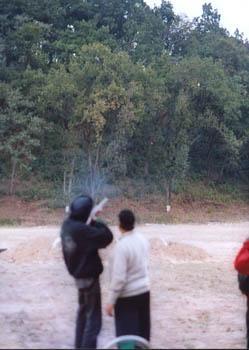
The photograph above was taken by Ra and shows the instructor and I, soon after I had fired the first two shots and had lowered the gun. The old man was telling me that I was firing along the correct line, but needed a lot more of practice.
I hardly managed to clip the wings of one or two of the birds that I shot at, but the whole experience, including the smell of the cordite, was a very heady one indeed!
Sunday, October 08, 2006
'Call'-ing Rock Fans...
The television set has conked out. My brother turned it off when he saw me dozing off, while watching it last night and now I can not seem to turn it on at all. If this does not get sorted out through repairs or replacements that are covered by the warranty, which has fortunately not run out as yet, I am going to be back to the pre-television era for an indefinite period (i.e. until I find a source of employment).
While I ruminate on all this and even as a return to the dark ages appears imminent, I reminisce about the sights and sounds that have reached me through what some refer to as the 'idiot box' and what has been my window to the world on long insomnia-filled nights over the past few months.
Even though I have been flipping through a lot of channels to escape the omni-channel-present commercial breaks, I have been watching quite a lot of music videos on MTV India. It is quite a treat to watch these at night as my tastes seem to vary quite a bit from the general public in India, on whose demand more of songs from the latest Hindi movies are aired than anything else, during the day time, on this channel.
Among the new arrivals on the musical scene in the sub-continent, two have been of particular interest to me. One is the Pakistani rock-band that call themselves, well, 'Call', and the other is an Indian artiste called Sidharth.
The Indian artiste's single called 'Panch Tatva' (the five elements) that is often on air has beautiful lyrics that say something to the effect that all human beings are made of the five elements and therefore, there should be no cause for strife amongst them. The video is also rather nice and shows the artiste walking on a beach, while singing the song. I am glad that some among Indian Rock- and Pop-stars still have the confidence to create a music video that does not have any semi-nude female models gyrating in the back-ground.
As for 'Call', they make good rock-music and can even conjure up some passionate songs in the galaa-phaad style (singing as if they aim to cause their throats to be torn apart!), a la Bon Jovi and Aerosmith or perhaps even AC/DC. Out of the three odd music videos from their album Jilawatan that are on air these days, Shayad is the one I like the most. It is a lovely song and has a strong social message as well.
What I do not comprehend though is the reason for choosing the name that the band-members have chosen for the band. I am sure they could have come up with a better one that would be more apt and do more justice to their talent.
They said in an interview that they chose it because 'Call' is the English translation of the Urdu word Pukaar. I would vote for the Urdu version any day!
While I ruminate on all this and even as a return to the dark ages appears imminent, I reminisce about the sights and sounds that have reached me through what some refer to as the 'idiot box' and what has been my window to the world on long insomnia-filled nights over the past few months.
Even though I have been flipping through a lot of channels to escape the omni-channel-present commercial breaks, I have been watching quite a lot of music videos on MTV India. It is quite a treat to watch these at night as my tastes seem to vary quite a bit from the general public in India, on whose demand more of songs from the latest Hindi movies are aired than anything else, during the day time, on this channel.
Among the new arrivals on the musical scene in the sub-continent, two have been of particular interest to me. One is the Pakistani rock-band that call themselves, well, 'Call', and the other is an Indian artiste called Sidharth.
The Indian artiste's single called 'Panch Tatva' (the five elements) that is often on air has beautiful lyrics that say something to the effect that all human beings are made of the five elements and therefore, there should be no cause for strife amongst them. The video is also rather nice and shows the artiste walking on a beach, while singing the song. I am glad that some among Indian Rock- and Pop-stars still have the confidence to create a music video that does not have any semi-nude female models gyrating in the back-ground.
As for 'Call', they make good rock-music and can even conjure up some passionate songs in the galaa-phaad style (singing as if they aim to cause their throats to be torn apart!), a la Bon Jovi and Aerosmith or perhaps even AC/DC. Out of the three odd music videos from their album Jilawatan that are on air these days, Shayad is the one I like the most. It is a lovely song and has a strong social message as well.
What I do not comprehend though is the reason for choosing the name that the band-members have chosen for the band. I am sure they could have come up with a better one that would be more apt and do more justice to their talent.
They said in an interview that they chose it because 'Call' is the English translation of the Urdu word Pukaar. I would vote for the Urdu version any day!
Saturday, September 30, 2006
The Tag of Weirdness
I have been tagged again. This time I am supposed to write about six of my weirdest habits/weirdest things about myself. I say 'weirdest' because, I can afford to pick and choose, being the epitome of weirdness as I am!
I am 'The Original Weirdo'!!
Anyway, here we go:
1. I am awfully thin. To be precise, I am stick-thin. The only thing I have inherited from the clan of warriors that I belong to, is my height. For all six feet of me, my weight fluctuates between 56 and 60 kilogrammes. Now, this does not bother me in the least, but the fact of the matter is that it seems to bug other folks a lot. Not only am I often subjected to expressions of 'concern' by relatives, but I am also prone to being stopped on the street by complete strangers, some of whom even offer to share 'remedies' to cure the 'state of my health'!
2. I have two fake front teeth. My folks pushed me into getting these installed, after one of my front teeth had fallen out, having decayed beyond repair. The adjoining tooth had to be ground to half its size so that a cap could be fixed on it to provide support for the fake tooth that replaced the missing incisor. They thought this might lead some girl to want to marry this weirdo son/brother/cousin of theirs. Little do they realise that I give most girls a complex because of my waist size, which the young ladies find difficult to match!
3. I have a very short attention span. Not only does my mind wander while I am on a bus or train, but also while in a meeting at work or when I was in class at school and college. To beat this, I had to ask questions very often, while in class. Due to this, some of my teachers at school and college even imagined me to be a very intelligent person, who had highly developed reasoning and logical abilities, only to be foxed when my average grades did not match their expectations. Also, my superiors at work have been bugged, more than once, by the uncomfortable questions I am wont to ask during meetings.
4. I am almost incredibly shy, on the personal front, and am unlikely to approach people unless absolutely necessary. Recently, I travelled to Nepal with a group of about 40 people (including my own family) and did not make a single friend and do not even regret it. Until a few years ago, I did get bothered by the fact that most people consider this as abnormal, but am comfortable being the way I am these days. What most people do not realise is that this gives me the unique ability to observe fellow human beings more closely than the majority of homo sapiens. So, 'His Weird Highness' rules his own little world!
5. To say that I have an 'unconventional' sense of humour, is a euphemism. Those who have been subjected to it would testify to that! The ones that manage to survive it become friends and the ones that do not, think I am among the weirdest men to have walked upon this Earth.
6. I try to live by certain principles that I hold in high esteem and have even suffered material losses on that account. That is definitely not the 'in thing' these days. The key word in today's world, perhaps, is 'flexibility' (which is actually 'moral bankruptcy', if you ask me).
So, TAG, I'M IT!
Monday, September 25, 2006
Democracy and the Rule of Law
In the past week, there has been violence in the national capital.
The protests organised by local traders against the sealing of the premises of bussinesses operating in residential areas, on an unauthorised basis, turned violent and four people went on to the happy hunting grounds after being shot by the police.
The sealing of unauthorised premises and the pulling down of unauthorised constructions has been going on intermittently in Delhi, as most readers are probably aware, in accordance with the orders of the honourable Supreme Court of India. This has been going on in spite of the fact that the political class and the bureaucracy have tried all that is within their powers, to create impediments. Attempts have been made to change the relevant regulations as well as to bring in fresh legislation at the state level and now the Union Urban Development Minister has declared that his government will consider a special session of Parliament to amend the constitution, so that those who have been breaking the law with impunity for several years can be protected against it.
On the other hand, the government in the state of Punjab has been acquiring agricultural land compulsorily from farmers with small or marginal land holdings. The compensation that the farmers are being paid in return for their source of livelihood is a pittance as compared to the market price of the land.
I believe there have been instances in some other states, as well, where agricultural land has been compulsorily acquired by governments and sold cheap to industrialists.
It has been reported that the chief of Congress (I) has advised the chief ministers of Congress-ruled states to go slow on the land acquisition, probably in view of the negative press that it has led to. Whether the farmers will get justice in the long run, however, remains to be seen.
The contrast is too stark to be missed. Those holding some of the highest offices in the land are eager to find a way to protect the Delhi-based traders against action ordered by the Supreme Court, even if that means changing the very laws that the traders have been breaking for a long time. The high and mighty, though, do not seem to mind snatching land from poor farmers.
I suspect it is simply because the farmers do not have the kind of money that the traders have and which the traders have been using to bribe the politicians and bureaucrats in return for not taking any notice of their illegal activities.
So much so for democracy and the rule of law!
The protests organised by local traders against the sealing of the premises of bussinesses operating in residential areas, on an unauthorised basis, turned violent and four people went on to the happy hunting grounds after being shot by the police.
The sealing of unauthorised premises and the pulling down of unauthorised constructions has been going on intermittently in Delhi, as most readers are probably aware, in accordance with the orders of the honourable Supreme Court of India. This has been going on in spite of the fact that the political class and the bureaucracy have tried all that is within their powers, to create impediments. Attempts have been made to change the relevant regulations as well as to bring in fresh legislation at the state level and now the Union Urban Development Minister has declared that his government will consider a special session of Parliament to amend the constitution, so that those who have been breaking the law with impunity for several years can be protected against it.
On the other hand, the government in the state of Punjab has been acquiring agricultural land compulsorily from farmers with small or marginal land holdings. The compensation that the farmers are being paid in return for their source of livelihood is a pittance as compared to the market price of the land.
I believe there have been instances in some other states, as well, where agricultural land has been compulsorily acquired by governments and sold cheap to industrialists.
It has been reported that the chief of Congress (I) has advised the chief ministers of Congress-ruled states to go slow on the land acquisition, probably in view of the negative press that it has led to. Whether the farmers will get justice in the long run, however, remains to be seen.
The contrast is too stark to be missed. Those holding some of the highest offices in the land are eager to find a way to protect the Delhi-based traders against action ordered by the Supreme Court, even if that means changing the very laws that the traders have been breaking for a long time. The high and mighty, though, do not seem to mind snatching land from poor farmers.
I suspect it is simply because the farmers do not have the kind of money that the traders have and which the traders have been using to bribe the politicians and bureaucrats in return for not taking any notice of their illegal activities.
So much so for democracy and the rule of law!
Saturday, September 23, 2006
Auto Rickshaw - A Socio-Mechanical Study
I simply had to link to the wonderful blog entry titled 'Light Within: Rickshaw - A Socio-Mechanical Study'.
It is an absolutely rocking piece about another commonality between India and Pakistan, which is also a popular mode of transport in the cities and towns of the sub-continent.
My brother and I nearly laughed our heads off, while reading it!
It is an absolutely rocking piece about another commonality between India and Pakistan, which is also a popular mode of transport in the cities and towns of the sub-continent.
My brother and I nearly laughed our heads off, while reading it!
Wednesday, September 20, 2006
A bundle of contradictions
The other day I had to attend a job interview.
The venue was a good thirty kilometres away and it had been quite a few days since I rode the bike. I had to get the air pressure in the tyres checked and, as expected, it turned out to be lower than the prescibed limits. It is always a good feeling to get the bike's tyres filled up with compressed air, since the ride feels so good afterwards.
I checked the oil-level as well, before leaving the petrol-pump, and it was fine.
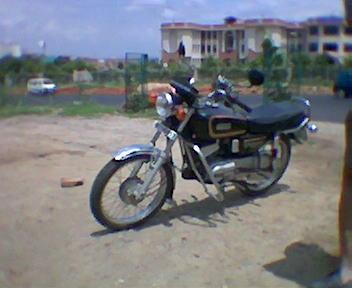
There is a traffic signal on the highway just after one leaves that petrol-pump and I had to stop there on account of a red light. As soon as the light turned green, however, I just took off with a grunt of the bike's engine. I love the way my bike's engine grunts and then sort of settles into a steady growl (I own a small Yamaha with a 135cc, two-stroke engine and sometimes can not seem to understand how those who own the four-strokers that are so popular these days, make do without the distinctive exhaust note that only a two-stroke bike can offer.). Of course, when we go beyond a certain speed the engine's sound becomes inaudible and all I can hear is wind whistling past my ears. It's an adrenaline rush that is very, very hard to beat!
I often wonder as to what could possibly beat the fun of riding a fast motor-bike. I think it could be something like flying an aeroplane like the one that Indiana Jones flew in the movie 'Indiana Jones and the Last Crusade' i.e. one with the cockpit open at the top.
Anyway, for a few minutes, I completely forgot that my bike's insurance policy had expired a few days ago and that being unemployed as I am, crashing the bike could land me in deep financial trouble, in addition to all the trouble it takes to restore the bike in terms of locating replacements for the damaged parts, as I found out to my chagrin the last time the bike and I took a tumble. I acquired some scars also, the last time, including some on the face, but then it's not as if I was a handsome hunk before that.
After the initial few moments of ecstasy, when the memories of the last road-accident did flash across my mind for an instant, I decided to control my agression just a wee bit, though not enough to spoil the fun completely (and limited the speed to about 85 kilometres an hour).
Later on, I was not selected for the job and the main reason given was that I was not found to be sufficiently aggressive (even though I fail to understand why on earth a Human Resources executive is required to be 'aggressive'). Perhaps I should have invited the lady who interviewed me, for a spin with me on my bike!
Monday, September 18, 2006
Opinions, Beliefs and Irwin
It seems like Steve Irwin induced strong reactions quite often, not only among animals, but also among people.
Here are a couple of articles, which appeared in a prominent Indian daily soon after he passed away and which represent two very different points of view regarding his life and times, besides his death:
Here are a couple of articles, which appeared in a prominent Indian daily soon after he passed away and which represent two very different points of view regarding his life and times, besides his death:
I think when one has strong opinions and beliefs and lives by them, one is bound to draw strong reactions, often bordering on the extreme, from others.
Friday, September 15, 2006
Irwin, India and the Stingray
The other day, the Animal Planet channel aired a 'marathon special' tribute to Steve Irwin that lasted for 24 hours and I managed to watch a good part of it.
Meanwhile, I have been following newspaper coverage related to Irwin's death in a tragic accident.
Here is one article that I found particularly interesting:
Meanwhile, I have been following newspaper coverage related to Irwin's death in a tragic accident.
Here is one article that I found particularly interesting:
A slice of ‘Irwin’s killer’ for Rs 30
Mumbai, September 7
For millions of animal lovers who watched the antics of Steve Irwin on Animal Planet, stingray may be a villain that claimed his life. But in Mumbai’s fish markets, slices of stingray are being sold for between Rs 20 and Rs 30.
“We cut up its tail and clean the fish thoroughly as soon as we catch it,” says Anita Koli, a fishmonger at the market in Central Mumbai’s Dadar. The fishing season is at present on and at least two vendors were selling stingray or ‘pakhad’, as it is called in Marathi, at the market. “There is not much demand for ‘pakhad’ as this fish has a funny taste,” says Koli.
Fishmongers say chefs from the big speciality restaurants buy pakhad and prepare it in a variety of ways. According to Ratna Koli, another fishmonger here, pakhad is filleted and each slice sold separately.
Since it does not move fast, pakhad has to often be kept in cold storage. Rather than being fried in a ‘rava’ batter like pomfrets or kingfish, pakhad is smothered in a rich coconut and tomato gravy to mask its taste.
Though the stingray available off the Western Coast is smaller in size, the fish catch may go up to 300 kg, according to fishmongers. They are, however, surprised that Irwin was killed by its sting. “It is poisonous and the skin turns blue,” says Ratna, though she has never heard of people dying following contact with it in India.
Inquries at popular Mumbai seafood restaurants like Apoorva and Trishna revealed that stingfish or pakhad is never on their menu. “Of course, if anyone places an order we can prepare any fish,” says Ramesh Karkera of Mahesh Lunch Home in downtown Mumbai.
(Source: http://www.tribuneindia.com/2006/20060908/nation.htm#16)
Wednesday, September 13, 2006
Book Tag
I have been tagged by a blogging-buddy and am supposed to write a bit about the books that I have read. I am not much of a reader, though, and have not read a book for quite some time now.
Anyway, here goes:
A book that changed your life
Sri Guru Granth Saahib, the holy book of the Sikhs, however, I have not read all of it as yet.
One book you have read more than once
Several...I used to read my comic books many times over, when I was younger, besides the 'Complete Sherlock Holmes Collection' and some of 'The Hardy Boys' series...
One book you would want on a desert island
Er...why just one...I would prefer a library, actually, complete with a chaise longue and a rocking chair, as well, besides a warm rug in front of the fire place, if you please...
Coming to think of it, a beach-chair and umbrella should also prove useful, for reading out of doors...
One book that made you laugh
Several...comic books mostly...
One book that made you cry
Don't recall any...
One book you wish had never been written
I am all for the freedom of expression!
One book you are currently reading
None.
One book you have been meaning to read
None...Even as, at one point of time, I used to read any book I could lay my hands upon...
Anyway, here goes:
A book that changed your life
Sri Guru Granth Saahib, the holy book of the Sikhs, however, I have not read all of it as yet.
One book you have read more than once
Several...I used to read my comic books many times over, when I was younger, besides the 'Complete Sherlock Holmes Collection' and some of 'The Hardy Boys' series...
One book you would want on a desert island
Er...why just one...I would prefer a library, actually, complete with a chaise longue and a rocking chair, as well, besides a warm rug in front of the fire place, if you please...
Coming to think of it, a beach-chair and umbrella should also prove useful, for reading out of doors...
One book that made you laugh
Several...comic books mostly...
One book that made you cry
Don't recall any...
One book you wish had never been written
I am all for the freedom of expression!
One book you are currently reading
None.
One book you have been meaning to read
None...Even as, at one point of time, I used to read any book I could lay my hands upon...
Saturday, September 09, 2006
The abominable face of terror
There has been a series of bomb blasts in Malegaon in the Indian state of Maharashtra, last afternoon. Evidently, these were aimed at people who had gathered for the friday namaaz (prayer). Several children are reported to be among the dead and injured.
Thankfully, just as in the case of the recent train blasts in Mumbai, the incidents have not been followed by any communal flare-up so far.
Sometimes, it seems to me that we, the citizens of India, share at least some of the blame for such violence. After all, we have not learnt to live in harmony even after 60 years of independence and our society has deep fissures along the lines of religion, caste, etc. Before independence, the blame was conveniently passed on to the British rulers and their so-called 'divide and rule' policy. Now, it is the various political parties and their vote-bank politics that are supposed to be driving wedges among us.
Will the Indian people never realise the truth and never learn to live in peace with each other and will those who deal in terror continue to try to take advantage of that?
The history of independent India does not offer much hope, I am afraid.
Thankfully, just as in the case of the recent train blasts in Mumbai, the incidents have not been followed by any communal flare-up so far.
Sometimes, it seems to me that we, the citizens of India, share at least some of the blame for such violence. After all, we have not learnt to live in harmony even after 60 years of independence and our society has deep fissures along the lines of religion, caste, etc. Before independence, the blame was conveniently passed on to the British rulers and their so-called 'divide and rule' policy. Now, it is the various political parties and their vote-bank politics that are supposed to be driving wedges among us.
Will the Indian people never realise the truth and never learn to live in peace with each other and will those who deal in terror continue to try to take advantage of that?
The history of independent India does not offer much hope, I am afraid.
Monday, September 04, 2006
Steve Irwin, R.I.P.
Steve Irwin is dead.
I have enjoyed watching his television series titled 'The Crocodile Hunter Diaries' on the 'Animal Planet' channel, for a long time now.
I sincerely hope that his death will not lead too many people to conclude that there is any thing wrong with the kind of work he was doing and that they will realise that accidents can and do happen.
Also, I hope that many more will imbibe his love for animals and take on the unfinished task of acquainting humans better with their co-habitants on planet Earth.
I have enjoyed watching his television series titled 'The Crocodile Hunter Diaries' on the 'Animal Planet' channel, for a long time now.
I sincerely hope that his death will not lead too many people to conclude that there is any thing wrong with the kind of work he was doing and that they will realise that accidents can and do happen.
Also, I hope that many more will imbibe his love for animals and take on the unfinished task of acquainting humans better with their co-habitants on planet Earth.
Friday, September 01, 2006
Nepal Visit (Part 3): Vroom...
The greater number of automobiles in Nepal are imported. I can not say none are manufactured in the country, for I suppose that a couple of motorcycle models are now being produced there in collaboration with a Chinese firm, but these do not appear to have a substantial market share, as of now.
Most automobile models that are available in India are available in Nepal as well. So, I came across quite a few familiar two and four wheeler models, upon reaching Nepal. There were a fair number of Maruti-Suzuki, Honda, Toyota and Hyundai cars, as well as Hero-Honda, Yamaha, Bajaj and even Royal-Enfield motorcycles, among others, that had obviously been imported from India. Besides these, there were trucks and buses produced by Tata and Ashok Leyland. Also, most of the taxis in Kathmandu are Maruti 800's.
However, I suppose the Nepalese started importing cars from India only after some of the popular international brands set up shop in the country, since I did not see any Premier Padminis or Ambassadors in Nepal.
A large number of vehicles are imported into Nepal from countries other than India, as well. I came across a large number of motorcycles, cars, trucks, buses and vans from Korea, Japan, Germany, China, etc.
In addition to the large and medium-sized SUVs (Sport Utility Vehicles) or 4x4s (Four Wheel Drive Vehicles) like the Toyota Landcruiser, Mitsubishi Pajero, Isuzu Trooper, Suzuki Vitara, etc., what caught my eye were the small ones like the Suzuki Jimny and the Daihatsu Terios. The only mini-SUV that I had seen on road before was the mini Pajero. I am not sure if these vehicles would be as much fun to drive as the mini Pajero that has a 2.8 litre engine, as compared to the 1.5 litre (approx.) engines that these have, but I definitely like the look of them.
Among the saloons (sedans) and hatch-backs that I saw in Nepal, some of Kia Motors' and Daihatsu's products looked really cute!
I also wondered why Hino has not launched its products in India, so far.
Another thing on wheels that I saw in Nepal and wished that it would soon be launched in India was the ubiquitous trail- or dirt-bike. Since the kind of surfaces that one often has to ride over in the Indian sub-continent quite closely resemble those on a motocross track, I am sure riding these bikes would be a lot of fun. I remember a couple of such models being displayed by Bajaj Auto during a recent Auto Expo, but these were never launched in the market for some reason or the other. I recall that one of these was to have a liquid-cooled 250cc engine.
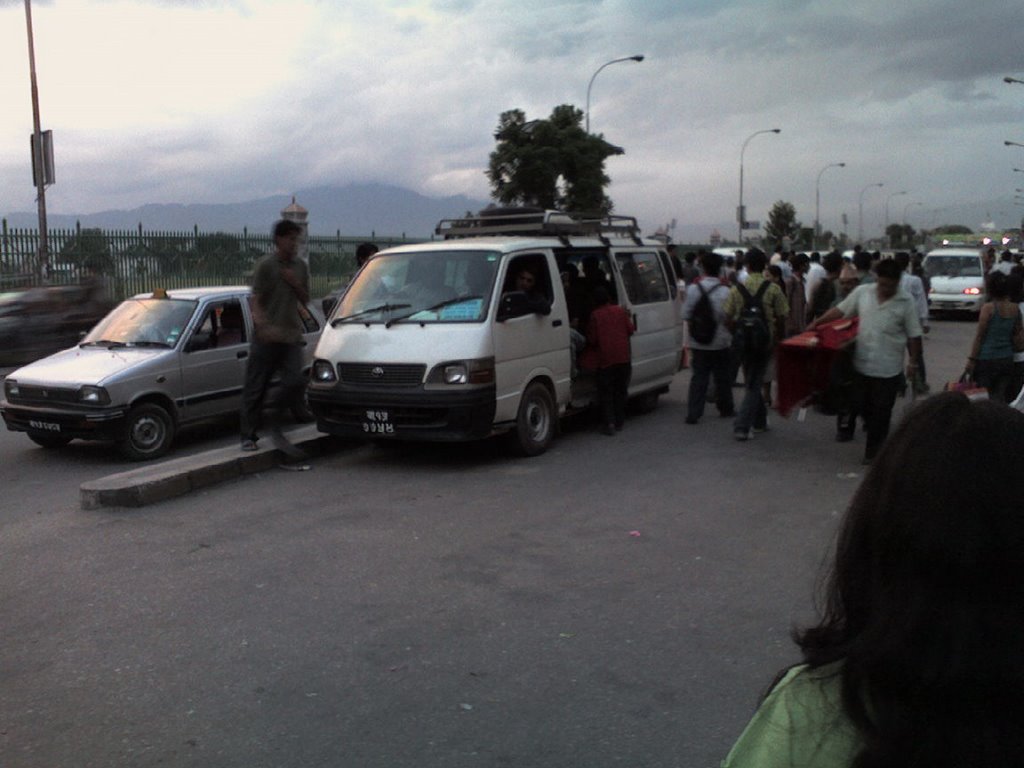
I was also impressed by the medium-sized vans (mainly Toyotas, as seen in the photograph I have posted along with this blog entry) that are used for public transport in the capital city of Kathmandu. These seemed like luxury vehicles, when I tried to compare these with the run-down buses and mini buses used to ferry common folk in Indian cities, towns and villages.
Friday, August 25, 2006
Nepal Visit (Part 2): Starry Starry Night...
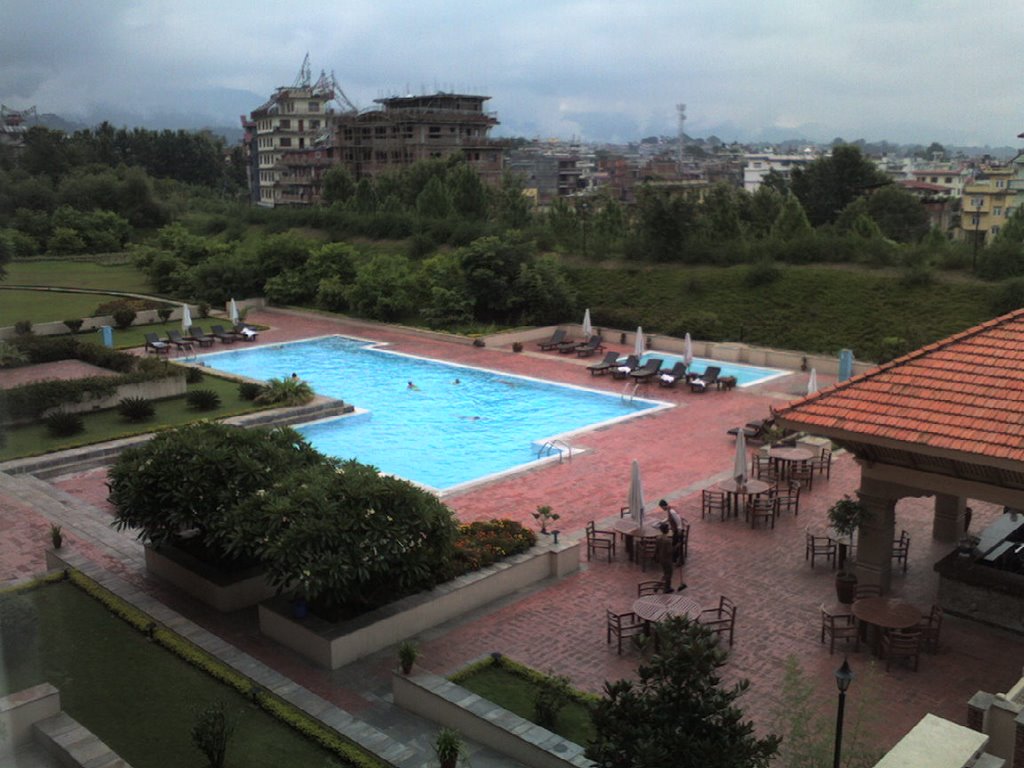
This trip marked another first, again for my mother, brother and I. It was the first instance that we actually stayed at a five star hotel. Earlier, we had been to such hotels for a meal, occasionally, but had never stayed at one.
This time, however, we were to stay for a couple of nights at the Hyatt Regency, Kathmandu, and obviously 'yours truly' was pleased-as-punch to be able to avail of this unique opportunity.
The fun started almost immediately after we landed at the airport on the afternoon of August 12, as the hotel had a van waiting to pick us up along with our luggage. And when we reached the hotel, my Ma just could not seem to trust the bell boys with the luggage. It took some effort on their and on my part to convince her that they would offload it safely from the van and bring it in and that we should go ahead and check-in without a worry in the world.
It was fun and games for the most part thereafter, except that it took some time for the hotel staff to confirm that free buffet meals at the hotel's cafe were included in the 'travel package' we had purchased. Well, it was fun for the likes of me and games for those who gambled with abandon at the hotel's casino. I would rather not throw away hard-earned money at a casino and I do not have any black money.
Anyway, the food at the cafe was quite exotic, I suppose, since there were so many items on the menu each time, the names of which had hitherto been unknown to me. I practised my skill at handling cutlery (particularly forks and knives), especially while eating non-vegetarian dishes and would like to think that I acquitted myself rather honourably, given the fact that the only piece of cutlery I need while eating at home is a spoon. But I might actually have overdone it a bit, since I used a fork and knife to eat doughnuts even, at breakfast!
Any hopes I might have harboured of getting an eyeful of pretty, young angreizens (white women) in bikinis by the pool-side, especially because my hotel room window provided an excellent view of the hotel's swimming pool (as can be seen in the picture posted above), were belied, though, and there was either no one by the pool side or it was teeming with fat old blunderbusses, whenever I took a peek. I, of course, did not venture any where near the pool, for I do not know how to swim and dreaded the possibility that the wind might start blowing too hard and carry me along into the water.
I did, however, get to ogle at some pretty young ladies, who apparently were models and were participating in a photo-shoot in the hotel's lawns as well as near the main entrance, for the ongoing 'Nepal Fashion Week'. None of them was in a bikini or other such revealing attire, and a tall one in a traditional ghaagra-choli, in particular, looked quite good.
Meanwhile, the rooms we stayed in were rather nice, with large, comfortable beds; comfortable chairs and stools for propping one's feet upon; a desk with a nice table-lamp; cabinets; a wardrobe; a small refridgerator that fit inside a cabinet; an electric kettle; a television set; a dressing table with a large mirror; colonial-era reading lamps placed on a bed-side chest of drawers; the works!
The bath room-cum-toilets were quite elegant too. There was a space enclosed by glass walls for taking a shower and a fair-sized bath tub, as well. I could not take a bubble bath like I have seen people taking in English movies, however, much as I would have liked to, because there was no soap solution (or whatever it takes to make a bubble-bath ready). Another thing that took a little bit or perhaps more than a little bit of getting used to, was the toilet paper. We Indians, like most people in the sub-continent, are used to washing our back-sides with water, after answering the call of nature.
In any case, another opportunity to stay at a five star hotel will be welcome, particularly if it is paid for by some one else, as was the case this time.
Subscribe to:
Posts (Atom)

 Posts
Posts


 www.HyperSmash.com